A neighbourhood woven through the family story
The Strand connects several parts of the Hawes story that are easily read in isolation. William Hawes the composer housed and trained choristers nearby, published music on the Strand and helped bring English-language opera to its theatres. His daughter Maria Billington Hawes grew into a professional singer, while his son William Henry Bartleman Hawes appears in a commercial directory as a surgeon on the same street.
Seen together, these addresses describe a family landscape: a place of work and household responsibility, of performance, teaching and trade. They also reveal the risks behind a musical career, including the failure of William’s publishing partnership and the disruption caused by the Lyceum fire.
From Craven Street to Adelphi Terrace
St Paul’s Cathedral Choir School’s archival description places William’s choristers at 27 Craven Street from about 1812, followed by a move to 7 Adelphi Terrace in 1817. At Adelphi Terrace, eight St Paul’s boys boarded alongside ten Chapel Royal choristers. The family home was therefore also part of the working machinery of London’s church music.
The 1841 census places William, Elizabeth and members of their family at 7 Adelphi Terrace. This was a household linked to music through work, training and family relationships. The address should not be confused with the Adelphi Theatre on the Strand.
Read the 1841 household transcript → · Choir School archival description
Behind the music: teacher and choristers
Hawes’s pupil Samuel Sebastian Wesley became a professional associate. But accounts of the boys’ treatment also belong here: sources describe corporal punishment and inadequate food within the training environment at Adelphi Terrace.
Read the Wesley connection and the choristers’ recollections →
Music as a business: 355 Strand
William’s activities extended beyond salaried musical appointments. He helped promote the Harmonic Institution, a cooperative publishing venture based at the Argyll Rooms in Regent Street. That enterprise belonged to a wider London network; it was not on the Strand itself.
After the venture failed and William went through bankruptcy, he continued as an independent publisher. The publisher history maintained by IMSLP places that business first at his Adelphi Terrace home and subsequently at 355 Strand. Publishing brought the practical business of selling and distributing music alongside composing, teaching and performing.
The precise date of his bankruptcy remains unresolved between published accounts. Its significance is clearer: commercial failure did not end his musical or publishing work.
William’s biography and financial history → · Publisher history
The Lyceum and the Adelphi: keeping opera alive
At the Lyceum’s English Opera House, William worked with Samuel James Arnold to develop a repertoire for English-speaking audiences. His adaptations brought continental works into the company’s performances; surviving parts of Marschner’s Der Vampyr at the British Library name him as the English-stage adapter.
After the Lyceum burned in February 1830, the company continued its summer work at the Adelphi Theatre. The 1831 calendar names William as director of music and records a season of 75 evening performances. These theatres were workplaces sustained by musicians, actors, management and paying audiences, with financial pressures as well as artistic ambitions.
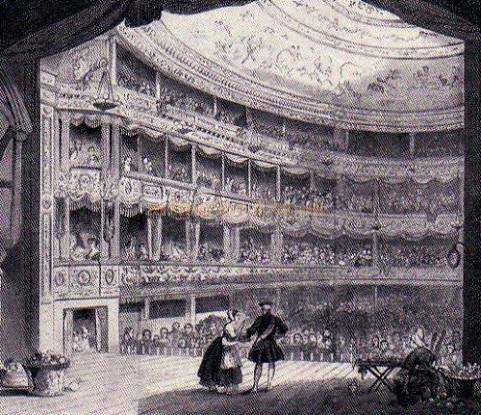
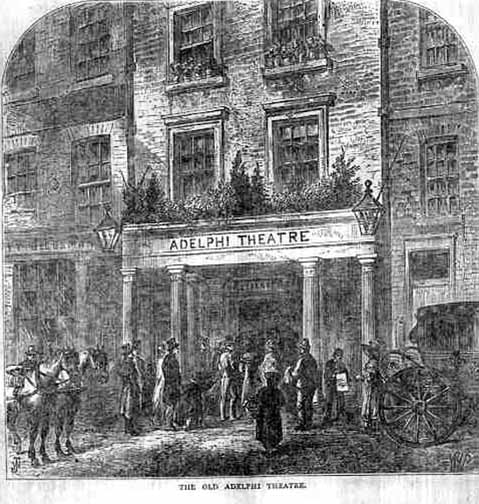
Explore the theatre illustrations → · British Library performance materials · Adelphi’s 1831 calendar
The next generation: a surgery at 406 Strand
A London commercial directory for 1852 lists “Hawes William H. B. surgeon, 406 Strand.” William Henry Bartleman Hawes’s professional life thus provides another family connection to the street. The entry establishes a practice address; it does not by itself prove that his family also lived there.
A bankruptcy notice in 1854 describes him as a chemist on the Strand. His financial difficulties were separate from those of his father, who had died in 1846.
Read William Henry Bartleman Hawes’s biography and directory sources →
The places at a glance
| Place | Family connection | Recorded period |
|---|---|---|
| 27 Craven Street | William’s accommodation for choristers | About 1812–1817 |
| 7 Adelphi Terrace | Family home, choristers’ residence; later publishing address | From 1817; household recorded in 1841 |
| 355 Strand | William’s independent publishing business | About 1830–1846 in publisher history |
| Lyceum / English Opera House | Opera adaptation and musical direction | 1820s–1830s |
| Adelphi Theatre | English Opera company’s temporary seasons | 1830–1831 |
| 406 Strand | William Henry Bartleman’s surgery | 1852 directory |
Addresses are presented as recorded in the cited sources. A workplace does not automatically establish a residence, and exact dates of occupation remain open where the evidence is incomplete.